Sabtu, 28 Mei 2011

2011 Aprilia Shiver 750 Startin Price From $9499

Displacement: 750cc

Bike Category: Street/Standard/Naked; Entry-Level; Commuter


Short Specification of 2011 Aprilia Shiver 750
Engine type dohc V-Twin
Displacement 750cc
Carburetion EFI
Transmission speeds 6
Final drive chain
Front brake dual disc
Rear brake disc
Wheelbase 56.7 in.
Seat height 31.5 in.
Fuel capacity 4.0 gal.
Claimed dry weight 417 lb.
List price $9499

2011 Aprilia Mana 850 GT ABS starting Price From $10,999

Displacement: 1000cc
Bike Category: Street/Sport


Short Specification of 2011 Aprilia Mana 850 GT ABS
Engine type dohc V-Twin
Displacement 839cc
Carburetion EFI
Transmission speeds 7 or automatic
Final drive chain
Front brake dual disc
Rear brake disc
Wheelbase 57.6 in.
Seat height 31.5 in.
Fuel capacity 4.2 gal.
Claimed dry weight 440 lb.
price $10,999

New Ducati Monster 796 Starting price From $9995

Displacement: 803cc


Short Specification Ducati Monster 796
Engine type sohc V-Twin
Displacement 803cc
Carburetion EFI
Transmission speeds 6
Final drive chain
Front brake dual disc
Rear brake disc
Wheelbase 57.1 in.
Seat height 31.5 in.
Fuel capacity 3.8 gal.
Claimed dry weight 369 lb.
Price $9995

2010 The new Kawasaki Versys is considered a sport bike

I was riding a Kawasaki Versys last week and thinking what a fine dual-sport bike this was. It handled well, the seat was reasonably comfortable, and was very agile. I had ridden one once before and it was in connection with a dual-sport event, so my "error" is easy to understand.

What's that about an error?

Well, looking for a few details about the Versys I went to the Kawasaki website. Hovering my cursor over the "Motorcycle" tab it brings up a sub-menu that offers, among others, "Sport" and "Dual Purpose." Mousing on over to that latter option, another sub-menu came up with three choices: KLR 650, KLX 250 SF, and KLX 250 S. Where was the Versys?


Looking around I found it under the--in my opinion--very unlikely category of "Sport." Wow, Kawasaki considers the Versys a sportbike? I never would have guessed. Just a kissing cousin to the Ninja 650R, right? I don't think so.

Granted that the Versys I rode last week had street tires on it. Nevertheless, the biggest giveaway was the seat height. Like any good dual-sport bike, this one is tall, 33.3 inches they tell us. Tippy-toes height for anyone with my 29-inch inseam. And how about that front suspension: 41mm according to Kawasaki. The same as the KLR 650 and just 2mm less than the other two dual-sports. But then, the Ninja 650R also boasts 41mm up front. (Gosh, what would that baby be like with knobbies?) Of course the riding position on the Versys is much more upright than on the Ninja, with the grips much higher.

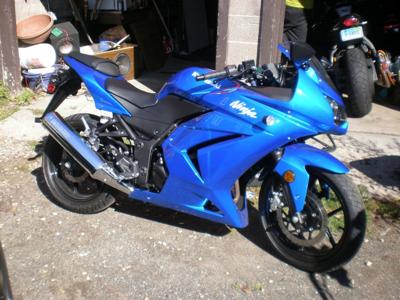
Detail kawasaki ninja 250

Look for "250" on this Kawasaki, and you won't find it. This was another appealing feature of the Kawasaki Ninja. Kawasaki has done a great job at hiding the fact that your "Bad Ass" new bike has a mere 248 CC displacement.

The Practical Features

The Kawasaki Ninja 250 is a lightweight street bike, weighing in at 300 lbs., yet can still reach speeds of 115 mph. A small, nimble motorcycle like the Kawasaki Ninja is great for the starter, because it has a 29.3" seat height. This low seat height is comfortable, and appeals to those riders who have a short inseam. Short riders are able to touch the ground with both feet.

Like an old friend, the Ninja is forgiving. If a new rider grabs too much throttle or grabs too much brake, not a lot happens. This motorcycle offers a gentler introduction to a beginner with its "pliant and forgiving gearbox." The beginner is not likely to spin the rear tire and/or dump the bike.

For the first time rider, choosing your first motorcycle is often a daunting decision. Now, more than ever, the motorcycle industry in North America is making high-quality, smaller displacement motorcycles that make excellent first motorcycles. But what bike is right for you? That really depends on a number of factors. In many jurisdictions, your choice in motorcycles may be limited by a graduated motorcycle licensing scheme. Often these systems limit your engine displacement or power-to-weight ratio rating. Be sure to check these details before purchasing a motorcycle.

The purpose of the bike is your primary consideration. Are you looking solely for a bike just to learn the basics? A 250cc bike or smaller, such as the Honda CBR125, or the Kawasaki Ninja 250, are both modern, high quality bikes that provide reliable mounts while you learn the ropes. The aforementioned Ninja can even manage highway speeds.

If you would like your first motorcycle to carry you past your first riding season, you may want to consider a motorcycle with a slightly larger displacement. Something in the 250-500cc range, such as the Suzuki GS500 or the Kawasaki Ninja 500 will allow for more than one season of riding. Larger displacement also means a larger bike, which may fit a slightly larger rider more comfortably, and also increase the feasibility of long range highway rides.

Blue color editions 2006 kawasaki ninja 250-R

Safety First - The Motorcycle Safety Foundation

His first smart move was taking advantage of the Motorcycle Safety Foundation Basic Rider's Class. Without prior riding experience, it's imperative to your safety and the safety of other motorists to get your initial instruction from the experts. The Motor Vehicle Safety Foundation offers a Basic Riders Class in cities and towns all over the US. Simply do a search by state and you will find several locations.

If your goal is to get your license to drive a motorcycle, this course will help you to achieve that goal. Start by getting your written permit, which costs about $30. The Basic Rider's class is a three-day, 14 hour course that costs approximately $275. Upon successful completion of the course, you will leave with your license.

Rather than rant and rave about how great this bike is for most of the article (and then dump on it at the end), I've decided to point out it's most obvious and debilitating flaws right away. If they don't bother you so much and you keep reading I know you'll love what you hear.

The Ninja 250R is limited by virtue of what it was built to be. At 249cc, it isn't exactly packing a whole ton of power. For those seeking mind-boggling acceleration and near-flight top speeds, the Ninja 250R isn't your bike (neither is the Ninja 500R or even 650R, either). For those seeking a bike that can pop wheelies at will, the Ninja 250R is definitely not your bike.

The size of the Ninja 250R is also limiting, as someone who is larger (in either height or girth) may find themselves looking more like a shriner than a rider. It also can be somewhat uncomfortable for those with long legs, as you have to really hug the bike.

New Blue 2009 kawasaki ninja 250r

Benefits of the Basic Rider's Course:

In addition to receiving expert riding instruction in a controlled, safe location, the Basic Rider's Course has several benefits:

* The rider leaves with improved skills and becomes a more defensive and observant rider.
* The BR course, in most states, will save you a portion of your motorcycle-endorsement test.
* Many insurance companies will discount, about 10% on motorcycle premiums every year, to students who have successfully completed a BR course.
* Some motorcycle distributors and brand-sponsored clubs will even reimburse all or part of your Basic Rider course tuition

My husband's Basic Rider class was a very diverse group of people, including: a doctor (Phd.); the twenty-something guys; the older retirees; and two thirty-something women. One woman, the mother of two kids, was getting her license and training so she could ride along side her husband. She is an inspiration, but not enough to get me to take the course, yet.

Popping wheelies, hitting 200mph, and going from 0 to 60 in three seconds are all things that will get you killed in a hurry. Fortunately, the Ninja 250R will not allow you to do any of those things. In fact, this little Kawasaki is limited in its velocity-related capabilities for good reason. Twist the throttle too hard and the rider won't find themselves eating an asphalt sandwich; apply a bit too much gas during a turn and the rider won't find themselves performing an aerial 360. This bike, by virtue of what it was designed to do, forgives you when you make small mistakes.

And, for a new rider (or a rider who doesn't want to deal with twitchy power bands), those are the very qualities you want in a bike. Smooth, linear acceleration (0 to 60 in just under 5 seconds is still very fast), with the ability to forgive you when you do it wrong. If only all relationships were so understanding.